
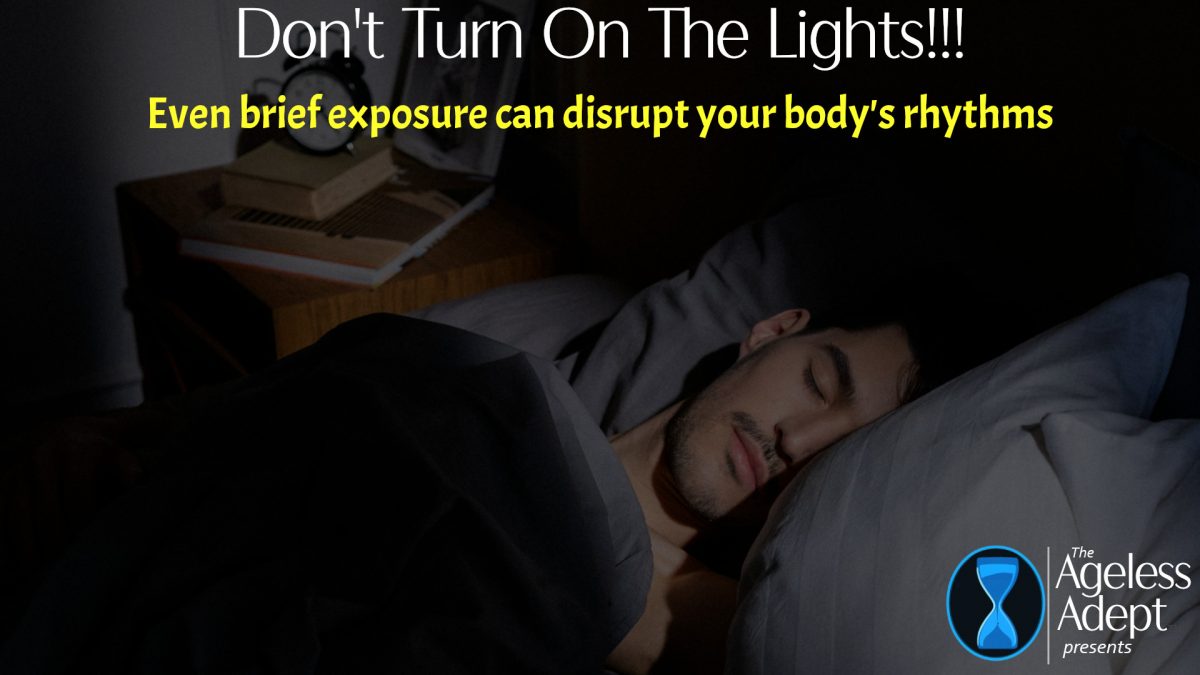
Quick Answer: Even brief exposure to bright light at night can suppress melatonin and disrupt circadian rhythms, affecting sleep quality and recovery.
Sleeping in complete darkness helps the body’s circadian rhythms for better sleep and repair. If I get up during the night and turn on the overhead lights for a minute or two, have I disrupted the process?
 Yes, even brief exposure to bright overhead light during the night—especially from blue-rich or cool white LEDs—can disrupt melatonin production and potentially affect your circadian rhythm, even if only for a minute or two.
🔬 What Happens When You Turn On a Light at Night:
| Action | Effect |
|---|---|
| Light enters your eyes (even briefly) | Signals the suprachiasmatic nucleus (SCN) in your brain (your circadian clock) that it may be “daytime” |
| SCN tells the pineal gland to stop producing melatonin | This suppresses or delays melatonin, the hormone that promotes sleep and night-time repair |
| Melatonin disruption | Can lead to lower quality sleep, reduced immune regulation, and impaired cellular repair overnight |
📉 How Much Disruption from 1–2 Minutes?
It depends on the intensity, wavelength, and timing of light exposure:
-
Overhead LED lights = worst case (high lux, high blue content)
-
Night lights or red light = minimal to no disruption
-
Timing: Light exposure closer to your usual wake-up time causes less disruption than early night or pre-midnight exposures
Even a brief light burst can cause:
-
Melatonin suppression for 30+ minutes
-
A phase shift in circadian signals (even if small)
-
Subtle effects on deep sleep quality and repair processes
✅ What to Do Instead
If you need to get up during the night:
-
Use a dim red night light (wavelengths above 620nm have minimal effect on melatonin)
-
Install motion-activated amber or red LED strips near the floor or under furniture
-
Avoid overhead lighting at all costs—those directly signal “daylight” to your brain
-
Blue light filters (on smart bulbs or apps) don’t go far enough at night—color temperature needs to drop significantly, ideally <2000K
🌙 Summary
Yes, turning on overhead lights at night—even for a minute—can disrupt circadian signaling, especially if it’s:
-
Before 3am
-
Using blue-white or cool LED lighting
-
Directly overhead or eye-level
Keeping your light environment sleep-friendly supports:
-
Melatonin production
-
Immune function
-
Hormonal balance
-
Cellular repair (especially in the brain, liver, and eyes)
Frequently Asked Questions
Does a minute of light really matter?
Yes, bright light can quickly signal the brain to reduce melatonin even with short exposure.
What type of light is least disruptive?
Dim red or amber lighting has minimal impact on circadian signaling at night.
How can I avoid disruption when waking at night?
Use low level motion activated lights and avoid overhead LEDs to protect sleep cycles.
A.I. Disclaimer
I encourage you to begin your own dialogue with AI to tailor recommendations to your specific needs. —The Ageless Adept
***
Save $$$ on Products I Use (Click Image to View All)
For discount coupon codes and direct links for some of unique health products I use, check out The Coupon Page —The Ageless Adept
***
-

The Sun Cure by Herbert Shelton (FREE!)
Price range: $0.00 through $9.95 Select options This product has multiple variants. The options may be chosen on the product page -

A Clean Cell Never Dies
Price range: $4.95 through $9.95 Select options This product has multiple variants. The options may be chosen on the product page -

The S.W.E.A.T Manifesto (FREE!)
Price range: $0.00 through $5.95 Select options This product has multiple variants. The options may be chosen on the product page


